Why Concentrates and Why Now?
Ready-to-use (RTU) liquid cleaning products remain extremely popular throughout the UK and Europe.
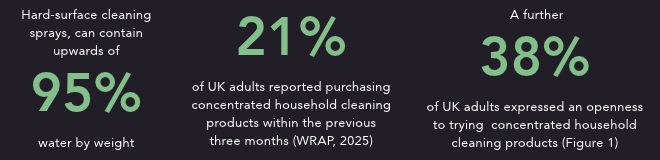
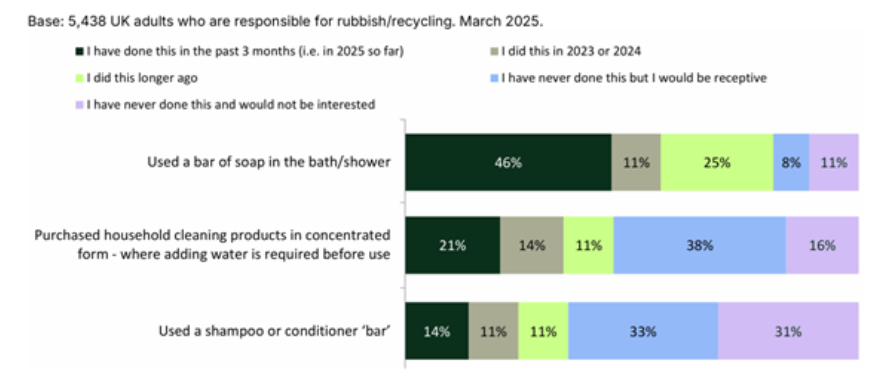
Figure 1 – Consumer engagement with concentrated household cleaning products, based on a survey of 5,438 UK adults (WRAP, 2025).
Why Choose Concentrated Cleaning Products?
Concentrated cleaning products offer several potential environmental and performance advantages. Perhaps most significantly, concentrates contain considerably less water, or in some cases none at all. This reduces the size, weight and volume of the product during storage and transportation, potentially lowering fuel consumption and associated transport emissions.
Transport Emissions
Figures published by BlocCarbon, based on the UK government’s 2026 greenhouse gas conversion factors, indicate that approximately 0.10356 kg CO₂e is generated per tonne of material transported each kilometre by an average heavy goods vehicle (BlocCarbon, 2026). Based on this value, Table 1 provides a simplified comparison of the emissions associated with transporting a conventional RTU surface cleaner and an equivalent concentrated format.
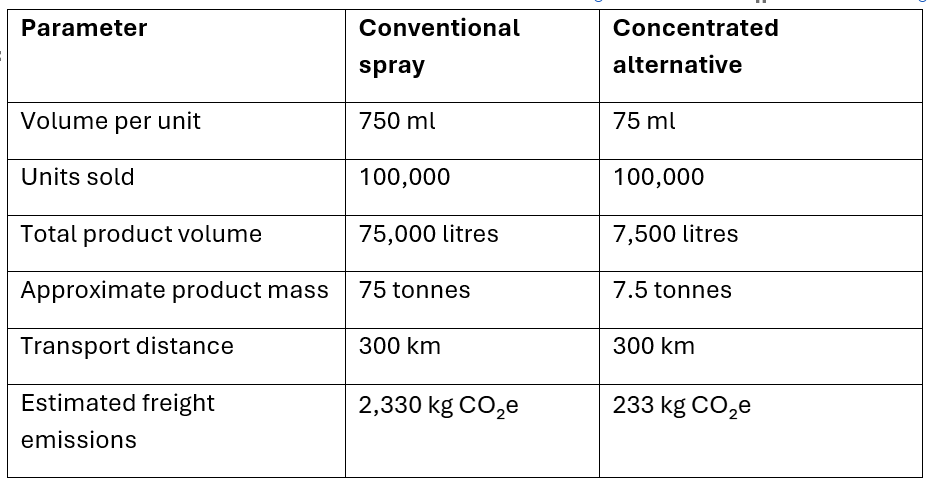
Table 1 – A comparative calculation of estimated road freight emissions for a 10× concentrate versus an RTU product transported over 300 km. Assumes equivalent product densities of approximately 1 kg/L and excludes packaging weight, transport utilisation and other lifecycle impacts.

Packaging
Packaging requirements can also be significantly reduced. A 75 ml concentrate generally requires considerably less primary packaging than its 750 ml RTU counterpart, potentially reducing the quantities of plastic, glass and cardboard required throughout the supply chain. Smaller packaging formats may also reduce storage requirements for retailers, distributors and end users.
Performance
Importantly, these benefits can be achieved without necessarily compromising cleaning performance. When correctly formulated and diluted, concentrates can deliver equivalent performance to RTU products, providing the same concentration of functional ingredients at the point of application.
What Are the Challenges of Concentrated Cleaning Products?
Despite their potential advantages, concentrated cleaning products introduce several challenges, particularly around safety, handling and ease of use.
From a consumer perspective, increasing the concentration of hazardous ingredients can result in more severe hazard classifications. For example, an RTU kitchen cleaner may be classified as irritating to the skin or eyes, whereas a concentrated version containing significantly higher levels of alkaline ingredients could meet the criteria for more severe classifications, such as H314, Causes severe skin burns and eye damage. The actual classification will depend on the ingredients, their concentrations and the relevant classification criteria.
Achieving the correct dilution rate can also prove challenging. Adding too much water may compromise cleaning performance, while insufficient dilution could result in excessive chemical concentrations, increased surface compatibility risks or unnecessary exposure to hazardous ingredients. Single-dose formats, calibrated dispensing systems and carefully designed packaging can help overcome these issues, although they may introduce additional costs or complexity.
Concentrated Formulations: What Are the Challenges?
Increasing the concentration of functional ingredients can lead to higher levels of electrolytes, solvents, surfactants and fragrances. This can introduce a variety of physical stability challenges, including precipitation, colour changes, phase separation, excessive thickening and gel formation.
Physical Stability
In highly concentrated surfactant systems, changes in composition can promote the formation of elongated micelles, lamellar liquid-crystalline phases and other ordered structures. These structures can lead to excessive viscosity, gel formation, poor pourability and processing difficulties.
Hydrotropes
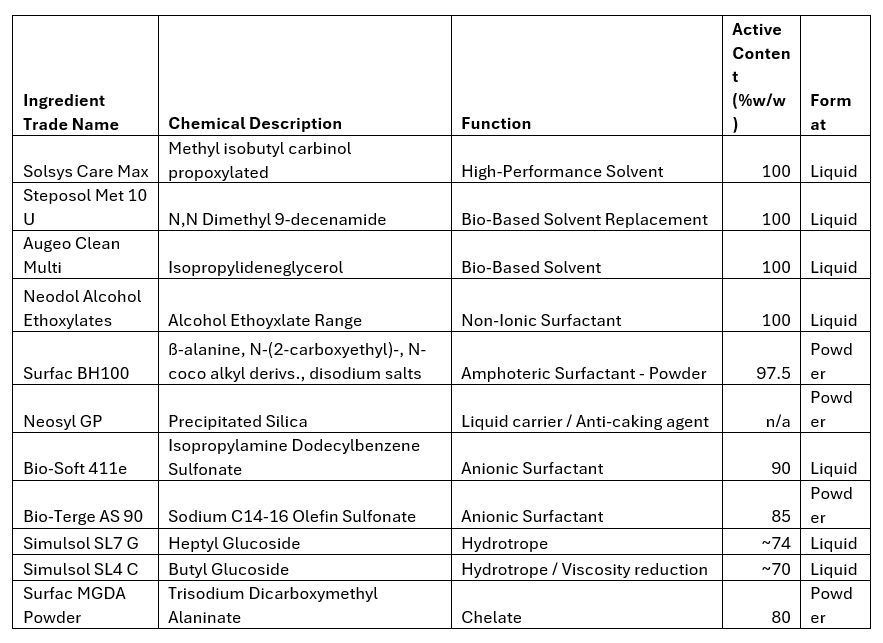
Hydrotropes can modify surfactant interactions and phase behaviour, helping to prevent the formation of highly viscous structures and maintain a stable, homogeneous formulation. They can also improve the compatibility of certain non-ionic surfactants in electrolyte-rich systems, reducing the risk of clouding or phase separation.
Chemical Stability
Chemical stability presents another challenge. Increasing ingredient concentrations can alter the chemical environment and, depending on the formulation, accelerate undesirable reactions between components. For example, higher concentrations of alkaline ingredients, oxidising agents or reactive surfactant systems may accelerate the degradation of susceptible fragrance components or other sensitive ingredients.
Consequently, developing a successful concentrate requires careful consideration of ingredient compatibility, surfactant phase behaviour, processing conditions and long-term storage stability. Formulations that perform perfectly well at RTU concentrations cannot necessarily be concentrated tenfold without significant reformulation.
Are Powder Concentrates the Answer?
Highly concentrated powder formats may overcome several of the shortcomings associated with liquid concentrates. By removing water, formulators can minimise certain unwanted ingredient interactions, potentially improve chemical stability and avoid liquid-specific physical stability challenges such as excessive viscosity and phase separation.
Advantages
- Powder formats allow the incorporation of solid materials, such as builders and bleaching agents, that may have limited solubility or stability in concentrated liquids.
- Sodium percarbonate (for example) can be incorporated into dry formulations but presents significant stability challenges in conventional aqueous systems.
Disadvantages
On the other hand, powder concentrates introduce a different set of complexities.
- Moisture sensitivity
- Caking
- Dust generation and ingredient segregation can complicate manufacturing and storage, while dissolution performance remains a critical consideration.
Unlike liquid concentrates, where ingredients are already dissolved or dispersed, powders must first undergo:
- Wetting
- Disintegration
- Dissolution
- Dispersion
Before their functional ingredients become fully available. This can present particular challenges in applications involving low temperatures, short contact times or limited agitation.
Powder concentrates must therefore be carefully formulated to balance storage stability, ease of handling and dissolution performance. The choice between liquid and powder formats ultimately depends on the intended application, ingredient compatibility and the practical requirements of the end user.
So, Are Concentrates the Future of Cleaning?
Whether liquid or powder, the success of concentrated formats ultimately depends on balancing these considerations with the practical needs of the end user. A concentrate that offers substantial environmental benefits but is difficult to dilute, unstable during storage or inconvenient to use may struggle to gain widespread acceptance.
For formulators and manufacturers, this presents both a challenge and an opportunity. Continued advances in surfactant chemistry, formulation technology and packaging design are helping to overcome many of the traditional limitations associated with highly concentrated products.
Perhaps the question is no longer whether concentrates have a place in the future of cleaning, but how much of that future they will occupy.
 ###
